No-code AI — Alias2Avatar for Alias Studio
An AI that answers from your data — configured and trained by you, without coding
Before diving into the details
Two worlds that look nothing alike
What you are offered elsewhere — and what we install on your machines.
AI elsewhere
they keep your conversations — and may exploit them (training, service improvement…)
Your AI, at home
even in streaming: questions and answers destroyed every night at midnight, local time
*depending on your machine's power
AI is present in the Alias Solo range too — it works behind the scenes. No training, no stream: your deterministic data is enough. No-code training and the AI stream belong to Alias Studio.
Understanding step by step
First the right words to talk about it, then the how and the why — the table of contents below is your first step.
Definitions
What are we talking about?
Agent
The foundation of our AI.
Click to flip
Agent
A specialized program, a single responsibility (find, verify, extract, compare…). Deterministic: same query, same result. This is the foundation of our AI.
Language model
Understands and formulates language.
Click to flip
Language model
The component that understands and formulates human language. It never decides the facts: it calls the agents and reformulates their results. We use several, each according to its responsibilities — all open-source, all running locally« locally » = on your machines.
AI
A system, not an intelligence.
Click to flip
AI
For us, it is not « an intelligence that talks ». It is a system: agents + a knowledge graphStructured representation of your data — categories, relations, terms — in memory. built from your data + language models, orchestrated together. Without agents, an AI becomes probabilistic: it no longer knows where to look and can inject erroneous content.
Not to be confused with mainstream conversational AIs: those generate the most probable answer. Ours finds the answer in your data.
Opposition
Deterministic, not probabilistic
A probabilistic AI generates the most probable answer. Ours generates nothing!
Your knowledge graphA structured representation of your data — categories, relationships, terms — held in memory. is the deterministic source of truth, projected from your business lexicon and other content sources according to your Alias ecosystem → Ecosystem page.
A business lexiconCategories, relations and terms specific to your activity. You configure it without any line of code. contains the categories, relations and terms specific to your activity. You configure it without any line of code.
Traditional AI
A model pre-trained on the web, by a company that does not know your business in every detail.
Alias2Avatar AI
A knowledge graph projected from your data.
+ technical detail
The Alias2Matrix engine projects your data into an in-memory graph. The resolution cascade is deterministic, by priority order: trained answers → business bridge → lexicon → graph → agent selection. Each step is deterministic. No hardcoded categories in the code.
Control
Piloted models, not dominant ones
Our open-source language models do not choose what to display. They select your agents — each according to its responsibilities — to retrieve your data from the knowledge graph and inject it into the chat. Full control from A to Z, as opposed to a probabilistic AI.
Deterministic answers rest on two foundations: your knowledge graph and your AI training — done by yourself, without any line of code.
No-code training
You train your AI yourself
You train your no-code AI with the technical vocabulary and stylistic expression forms specific to your company. A visual and didactic interface makes training easy.
The prerequisite: your documents work for you.
No full manual entry: the tool automatically extracts and structures information from your content — PDFs, spreadsheets, or any other usable document form — as descriptive labels. These labels classify uploaded content (RAG tags); they are proposed automatically from the first indexing. The more documents you index, the more the tool learns to classify content — manual selection decreases on its own. This preliminary automatic sorting represents a considerable time saving.
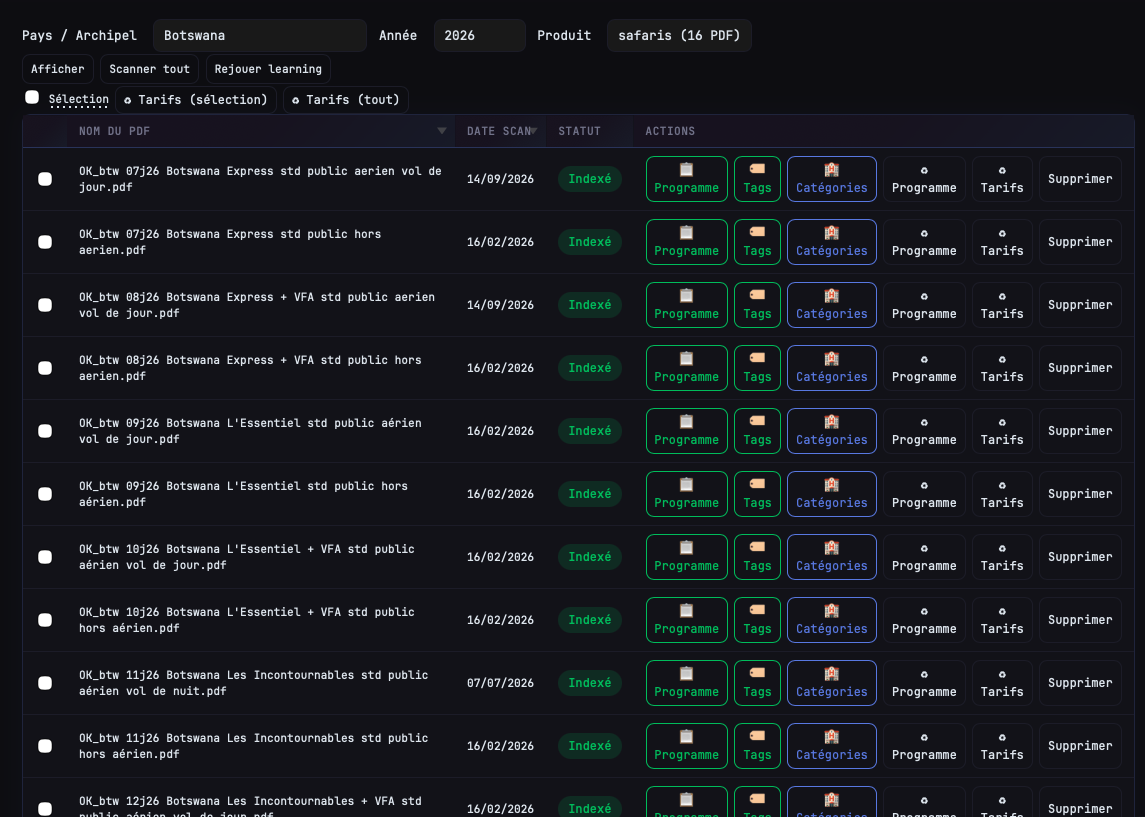
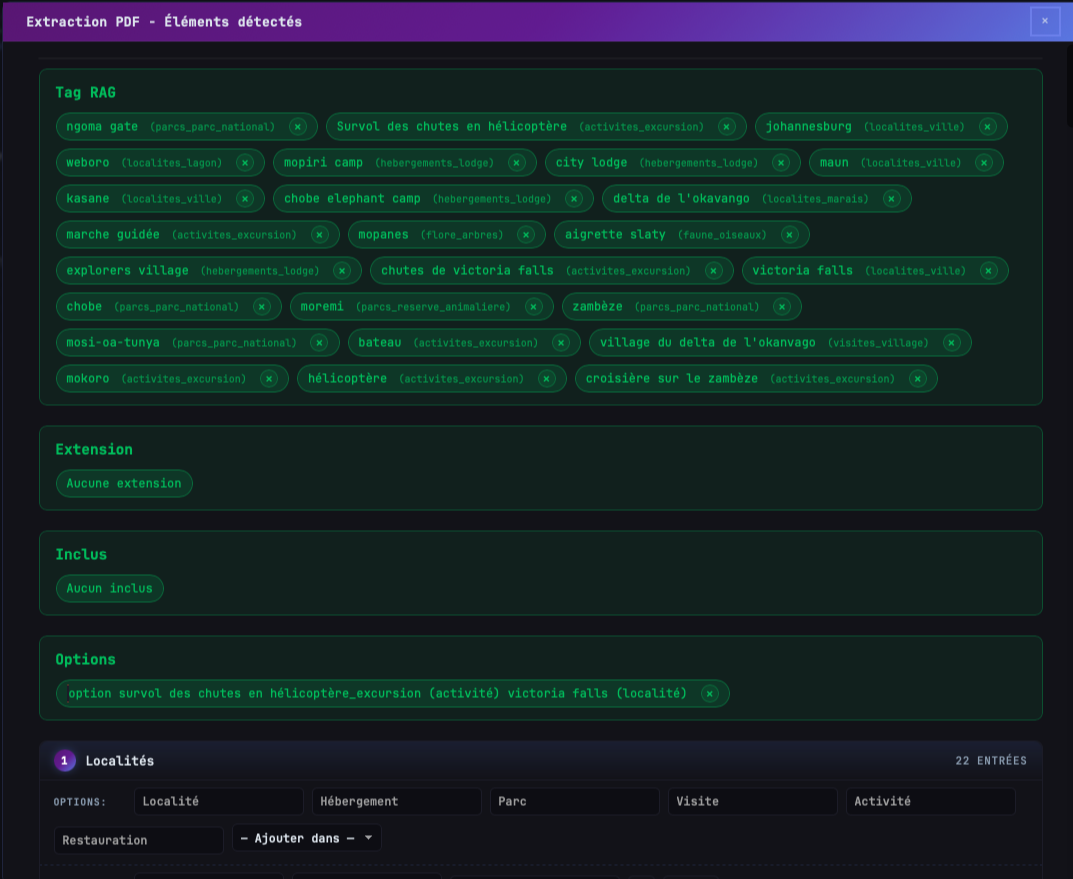
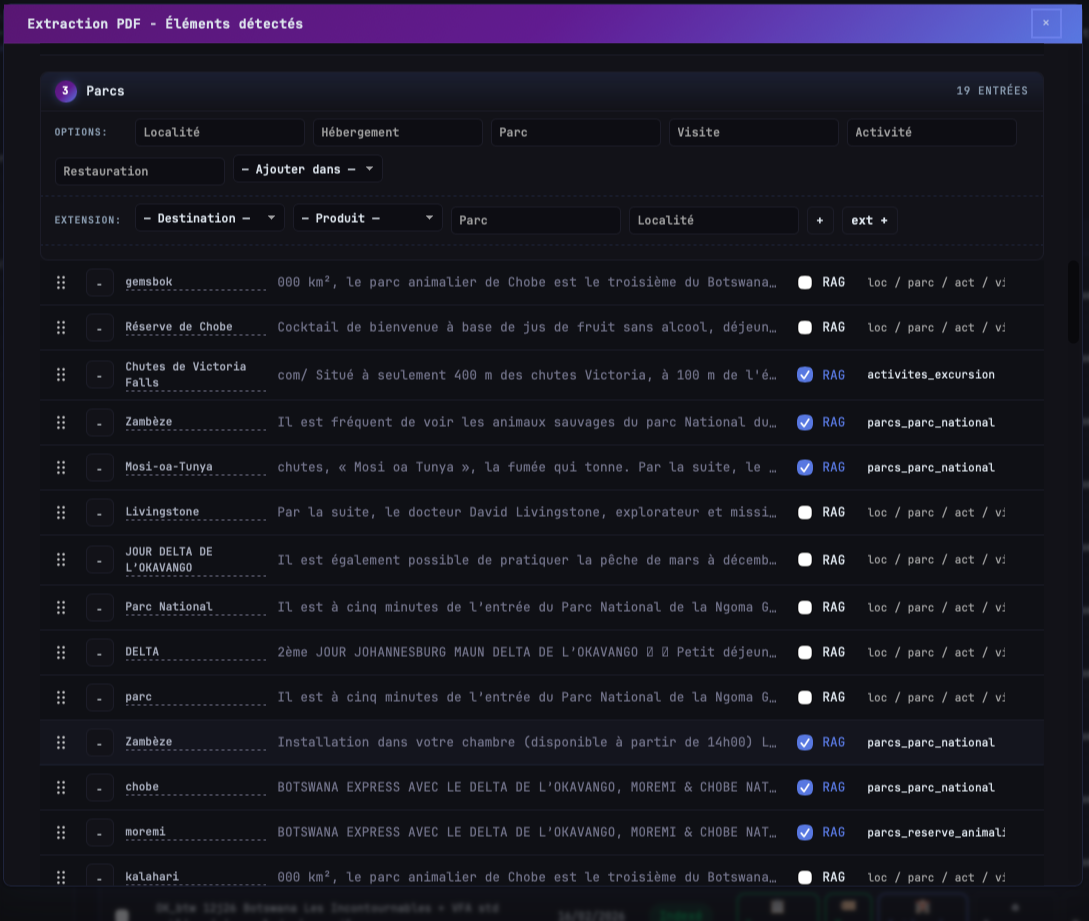
Show caption for each image
Document management interface — tourism case study. Every uploaded file is indexed automatically. To update it (program, pricing), just replace the PDF and click: the database is updated immediately, and the knowledge graph with it.
The lexicon: where to find each piece of information.
Your business lexicon — categories, relations, terms specific to your activity — is configured without any line of code. Key point: the AI learns where to find the information, not its exact content. Change a price or any data: the answers update themselves, without re-training anything.
Cover dozens of cases without listing them.
MarkersVariable placeholder in a response — e.g. {destination} — that automatically covers all possible values. insert into your answers and automatically cover all possibilities: {destination} instead of writing « Kenya », « Tanzania », « Zambia »… A visual interface lets you indicate precisely what {destination} corresponds to in order to retrieve individual data.
Screenshot or video to come
MEDIA · ianocode-s3-e3
Link your categories together.
You drag your categories onto a canvas — for example, for the tourism business: destination, products, programs… You thus describe a context visually. Then, you select for each the filters that refine it. Then create the relations between them: this is the role of the query sentence — a small guided language, without code, that links your categories (contains, belongs to…) and combines them with « and » / « or ». These relations are what makes your knowledge graph work, the deterministic source of truth. This is the foundation of training so that the answers displayed by your AI in the stream come from your deterministic data, thereby eliminating any hallucination.
Verify that it works.
A question/answer simulation process checks two things: the knowledge graph content is properly accessible, and the answer displayed in the chat contains the necessary elements. At this stage, we validate the deterministic data — not the form yet.
Organize your conversations into a workflow.
An exchange is not a sequence of isolated answers: your scenarios link together, you define what follows what. At each interactionAny visitor action in the conversation — a question, but also an answer, a request, a choice. from the visitor, the AI answers — and, when relevant, follows up with a question (it is this follow-up that allows the workflow to determine the expected scenarios and optimize the use of the source of truth in the stream). For each question the AI may ask, you declare the expected answers: the tool verifies that you have covered them all. The conversation stays channeled toward your source of truth — never toward improvisation.
Refine the form.
You write stylistic variants of the answer displayed in the chat, once the previous steps are successful.
Without code, prompts, or model tuning.
+ technical detail — summary of the 7 steps
Automatic extraction is deterministic and controlled: each assigned label is subject to human validation before integration. Relations between categories are built via a guided query sentence (without code), making the graph traversable for deterministic routing of questions. The knowledge graph is loaded in memory for immediate resolution. Conversational orchestration is deterministic: declared sequences between scenarios, completeness audit on expected answers. A cohort of agents continuously controls consistency between labels, lexicon, markers, workflow and chat behavior; a deterministic reward system validates the quality of question ↔ training matches before styling.
Uses
Two uses, one same AI
Solo
Solo — the AI assists you on your machine: long-form writing, library, managing your cash flow, automation agents for your everyday tools. → Solo page
Studio
Studio — your AI continuously answers the users of your organization or site. It is configured and trained by you, locally, on your machines. → Studio page
Improvement
It improves with use
The more your AI works, the more it covers your business. What it has not yet learned is flagged: you refine its training so it has the new answer elements once — it knows them forever. And since training is about how to find the information, not its content: a changed data point automatically propagates into the answers, without re-training.